The skyline at Princep Ghat pulled off an act on June 20 that even the greatest of stages and screens, as well as fireworks displays, could not match. The International Yoga Day drone show at Kolkata showcased how yoga has gone from being a point of absolute calmness to become a driving force behind the history, freedom movement, festivals, and families of a country.
This Kolkata drone show was conducted by BotLab Dynamics as part of a three-day-long celebration all across India to celebrate the 12th International Day of Yoga under the theme of "Yoga for Healthy Ageing."
This was not a small undertaking. Kolkata was hosting one of India's largest International Yoga Day celebrations this year, and the city had three full days to live up to that scale.
A City-Wide Celebration, Not Just a Single Evening
These festivities kicked off on June 19, which saw Daud Se Dhyan - a yoga run across 11 locations in Kolkata. The message was clear from the very beginning – this was no singular event taking place in one night. This would be an event spanning the entire city and asking people to consider their health, mindfulness, and community all together.
June 20 saw the spectacle of the Kolkata drone show along with a cultural carnival taking place at the Princep Ghat and Millennium Park. These were two technologies coming face-to-face on one day.
The drone show on June 20 was the bridge between the energy of the run and the gravity of the main event. It needed to carry weight without the benefit of a podium or a microphone. It had to say something using only light, formation, and timing.
Building a Show Around an Idea, Not Just an Occasion
The creative direction for this Kolkata drone show started from a simple but demanding brief: don't just mark the occasion, tell its story. A generic light show would have looked impressive for a few minutes and been forgotten by the next morning. BotLab Dynamics built something with a beginning, a middle, and an end instead.
The show opened with a single glowing bindu, pulsing outward into the dark sky above the Hooghly. From that point of stillness, a golden lotus bloomed, and from within its petals, the Earth itself rose and turned gently above the water. It was the kind of opening that makes a crowd go quiet before it makes them reach for their phones.
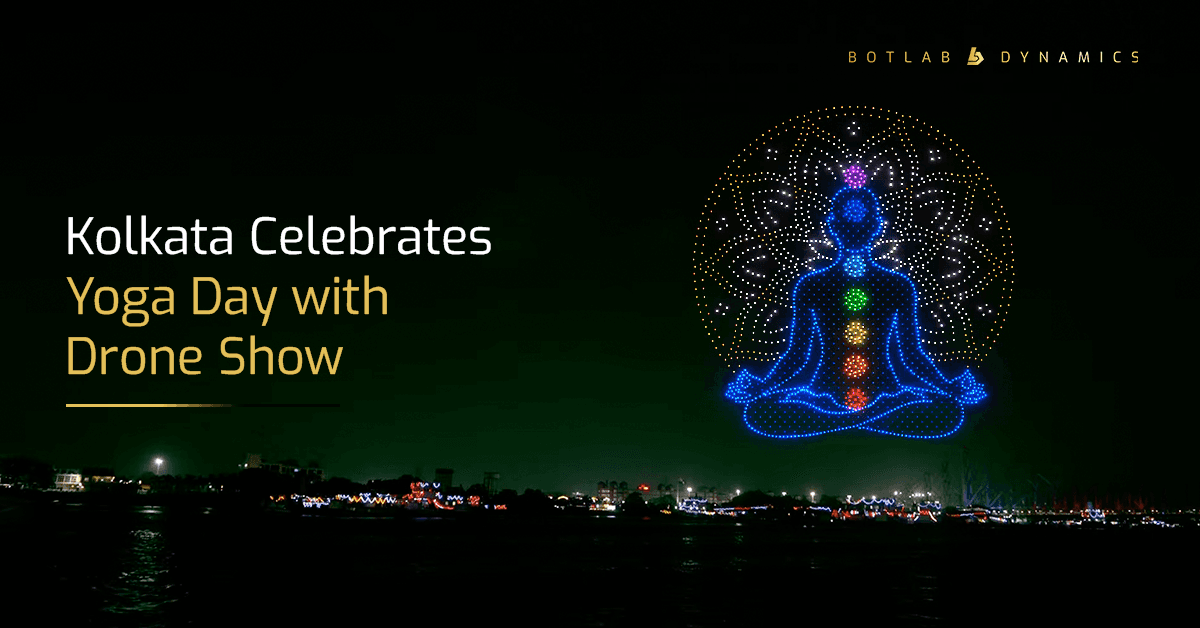
From there, light radiated from a formation of Om down onto a glowing map of India, striking the Himalayas first and tracing its way toward West Bengal, illuminating the path of the Ganga-Hooghly along the way. A giant meditating yogi appeared next, seated in Padmasana, with all seven chakras lighting up in sequence from base to crown as a mandala bloomed behind the figure. It was easily one of the most technically demanding formations of the night, and one of the most visually arresting.
Honouring the People Who Carried Yoga Beyond India's Borders
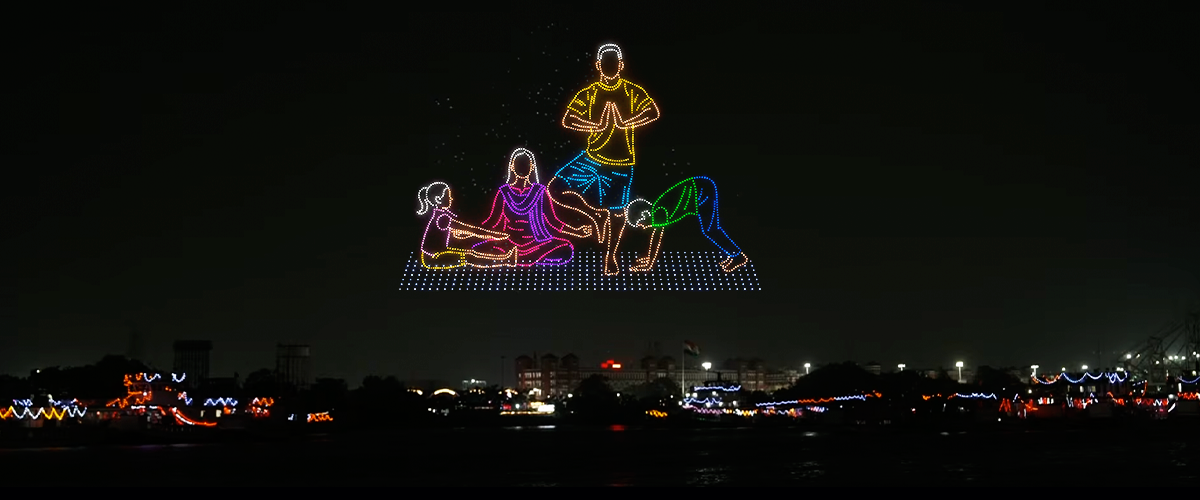
What made this International Yoga Day drone show in Kolkata distinct from other aerial spectacles was its decision to honour specific people, not just abstract ideas. Seven Surya Namaskar poses unfolded one after another beneath a glowing sun, performed by drone-rendered figures spanning every age group, a deliberate visual echo of the show's healthy ageing theme.
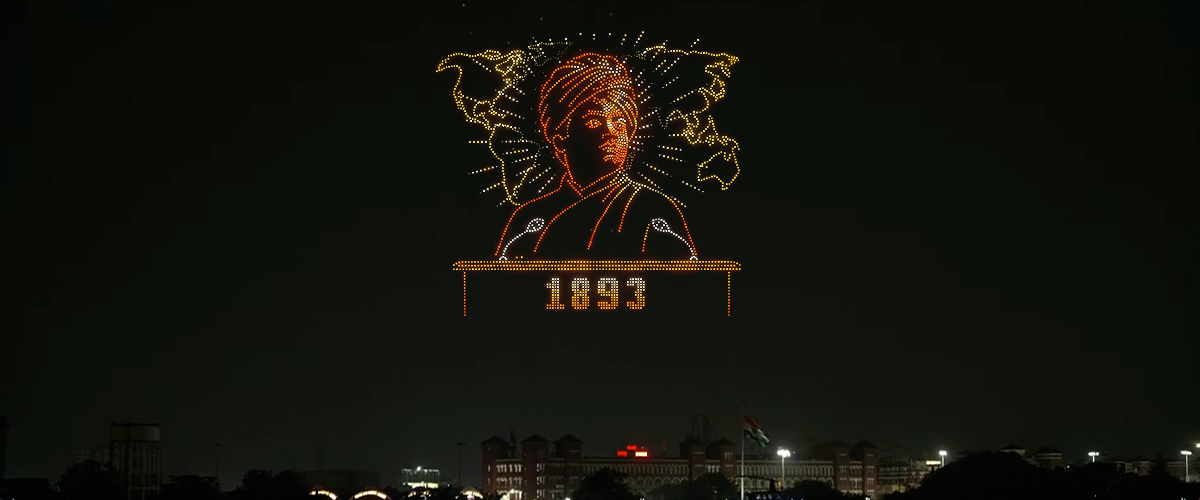
There were the portraits next. First, Swami Vivekananda, in shades of saffron and gold, on the globe, with the year 1893 shining below him, a subtle reference to his speech in Chicago where he first introduced yoga and Vedanta to the Western world. Then there was Rabindranath Tagore, holding an open book, from whose pages came birds turning into a tree of knowledge. Next were Sri Aurobindo and Paramahansa Yogananda, haloed in their glow, two individuals who spread the thoughts of spirituality in India to audiences beyond Bengal and even beyond India.
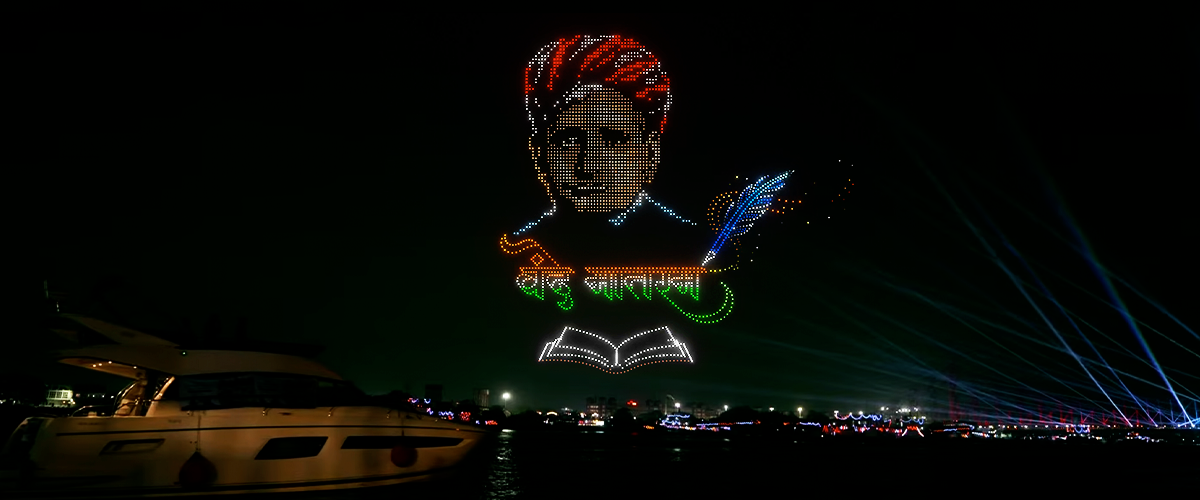
The portrait of Bankim Chandra Chatterjee came next, with a pen in his hand and "Vande Mataram" in script below him. This was a formation that referred to the specific contribution of Bengal to the cultural and political awakening of India, something which made this show in Kolkata uniquely local.
Family, Home, and the Quiet Power of Inclusion
One of the most resonant formations of the night had nothing to do with history or mythology. It was simply a family doing yoga together, a father in tree pose, a mother in padmasana with a child in her lap, another child stretching nearby. After portraits of saints, freedom fighters, and global icons, this formation brought the evening back down to something every single person watching could recognise from their own home.
The show then turned toward governance and place. A dignified portrait formation paid tribute to the Hon'ble Prime Minister, with "Yoga Comes Home" forming above it, a formation that spoke to the broader national moment building toward his address at Red Road the following day. A portrait honouring the Chief Minister followed, layered against the outline of West Bengal with the word HOME glowing across the state's silhouette.
Closing Where Kolkata Lives
The final sequence brought the show home, quite literally, to Kolkata's own landmarks. Three formations in succession showed Ma Durga's eyes rising above Belur Math, then Howrah Bridge, then Dakshineshwar Kali Temple, each one a different geography of the city rendered against the goddess whose presence defines Kolkata's cultural identity more than perhaps any other symbol.
The show closed with Ma Durga's full avatar, seated on a lotus, showering blessings over the gathered crowd below. After history, philosophy, family, and government, the evening ended exactly where Kolkata's own heart sits.
Why This Matters Beyond One Evening
Drone shows have increasingly become the format of choice for marquee public celebrations across India, and this International Yoga Day drone show in Kolkata is a clear example of why. A few hundred metres of night sky can hold a narrative arc that a stage performance, however well produced, struggles to match at the same scale and for the same size of audience.
This is also a shift in how cities choose to celebrate. Public commemorations are no longer just marches, speeches, and static decoration. They are increasingly becoming shared visual experiences, watched simultaneously by people standing at the venue and by people scrolling through their phones the next morning. A drone show carries a built-in afterlife that a live address does not.
For BotLab Dynamics, the Kolkata show adds to a growing body of work built around the same conviction: a drone show succeeds not because of how many drones are in the air, but because of whether the story in the sky actually means something to the people standing beneath it. On June 20, over Princep Ghat, it clearly did.