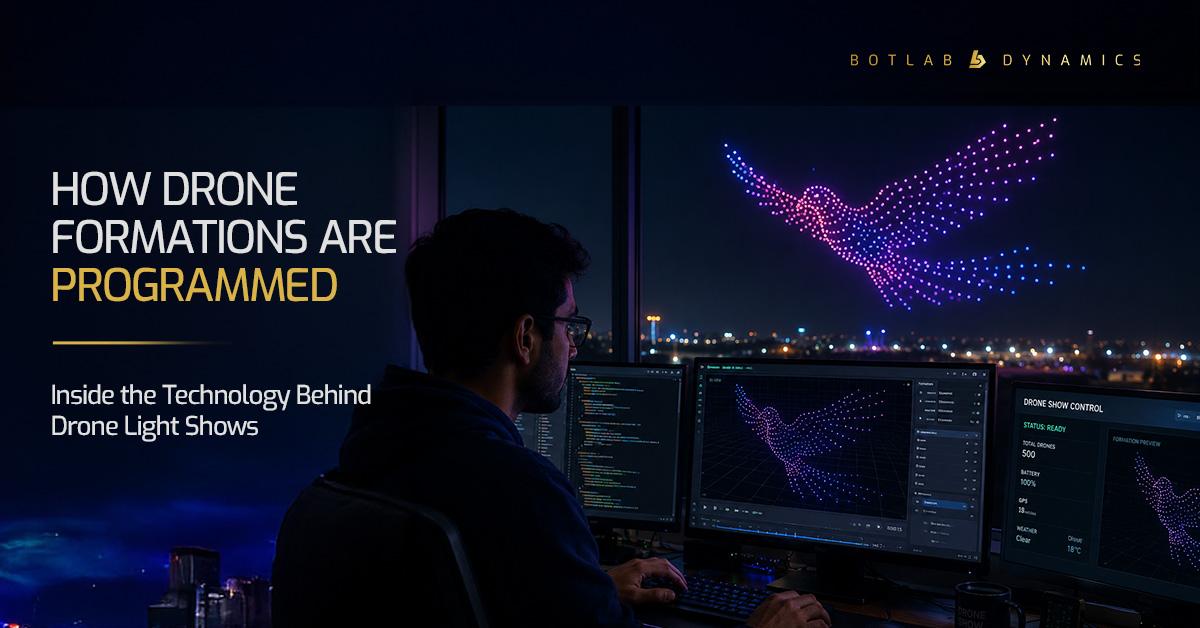
Have you ever been intrigued by how drone formations make those beautiful shapes in the sky? Find out how drone formations are programmed by visiting this blog, which uses some of the real-world experience gained at BotLab Dynamics.
Programming drone formations involves the use of dedicated software that will turn visual images into flight path coordinates for individual drones in a formation. Those flight path coordinates can be synchronized via GPS, swarm intelligence algorithms, and real-time communication systems.
A show of drones from the ground appears almost magical, with perfect circles, animations, and logos appearing out of thin air. Everything seems simple enough. However, there are weeks of effort put into those seemingly effortless 15-minute shows.
One thing is very obvious at BotLab Dynamics: drone formations do not "just happen." Drone formations are created through meticulous planning months before a drone takes to the sky.
While controlling a drone is no mean feat, coordinating hundreds of them together is even harder.
What does it mean to Program Drone Formations?
Programming drones for a formation is essentially converting the concept that you visualize into code that the drones would follow. It's like dancing, where you need the dancers to follow your choreography; except here, each dancer is a GPS-guided drone receiving its own unique flight script, with positions calculated to the centimeter and timing synchronized to the millisecond.
To begin with, the designers have an idea that could be a logo, a symbol, or even a complete animation. This is then converted into coordinates and a movement pattern. Each drone is then programmed accordingly.
Thus, even when we see a particular formation, it is nothing but drones flying independently in perfect synchronization.
Why Programming Is the Most Critical Part of a Drone Show?
Here’s the catch. Even the best drones in the world can’t compensate for poor programming. From our experience at BotLab Dynamics, most issues in drone shows don’t come from hardware; they come from how the show is designed and executed digitally.
Programming determines:
- How smooth transitions look
- Whether formations are clearly visible
- How safe are the drones when operating in proximity
- How efficiently the show runs
Programming largely determines the safety, accuracy, and visual quality of a drone show.
Step-by-Step: How Drone Formations Are Programmed
1. Concept and Storyboarding
Every show starts with an idea. For government events, it might be national symbols. For brands, it could be logos or product storytelling.
At BotLab Dynamics, this stage is heavily collaborative. We work with clients to define what needs to be communicated. Once the concept is clear, it’s translated into a storyboard. This outlines every formation and transition.
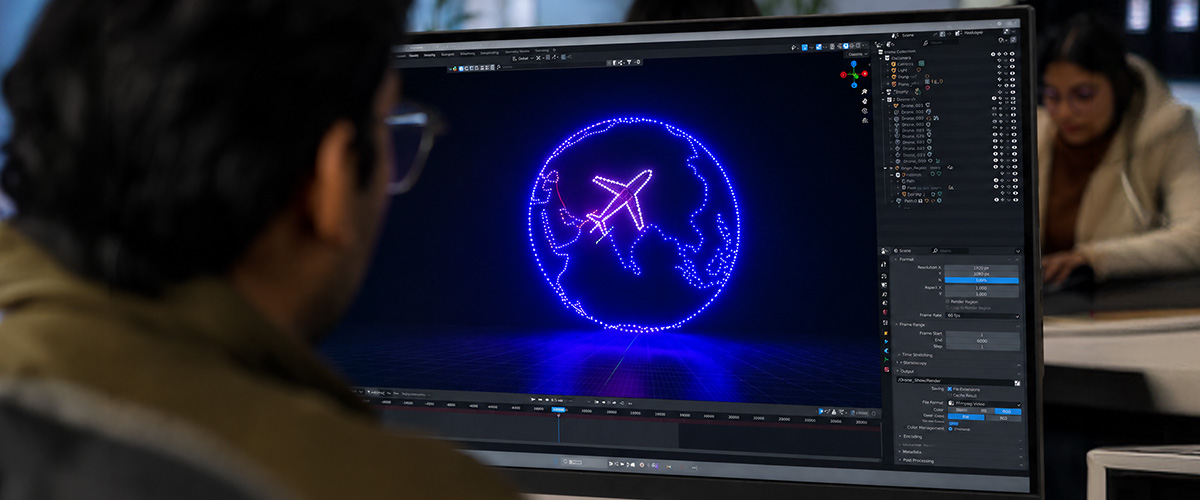
2. Designing the Formations
Next comes the visual design. Using specialised software, designers create 2D or 3D formations. These designs are not just artistic: they are technical. Spacing, scale, and visibility all need to be considered. A design that looks great on screen might not work in the sky.
This is where experience matters. We’ve seen designs that look perfect digitally but lose clarity when scaled to 300+ drones. Adjustments are constant.
3. Path Planning and Drone Allocation
Now comes the complex part.
Each drone is assigned a path. This includes:
- Starting position
- Movement trajectory
- Speed and timing
- Final position
The goal is to ensure smooth transitions without collisions. This process uses advanced algorithms to calculate optimal routes. Think of it as air traffic control, but for hundreds of drones moving simultaneously.
4. Simulation and Testing
Before anything goes live, the entire show is simulated. And not just once. At BotLab Dynamics, we run multiple simulations to test:
- Formation accuracy
- Timing synchronisation
- Collision risks
- Environmental factors
Here’s where most corrections happen. Because once drones are in the air, there’s very little room for error.
5. Real-World Calibration
Simulation is one thing. Reality is another. Before the actual show, drones are calibrated on-site. GPS signals, wind conditions, and terrain all affect performance. This step ensures that what was programmed matches real-world conditions.
6. Execution and Monitoring
During the show, drones are controlled through a central system. Operators monitor:
- Drone positions
- Signal strength
- Flight behaviour
Even though everything is pre-programmed, real-time monitoring is essential because live environments are unpredictable.
Technology Behind Drone Formation Programming
Controlling the drones’ formations goes beyond writing code. It requires various technologies to be used in harmony.
- Swarm Technology: This technology enables the use of several drones in one formation. Rather than individually controlling the drones, control signals are sent collectively.
- GPS and RTK Navigation: Accuracy is key here. RTK, which stands for Real Time Kinematics, enhances GPS accuracy by providing centimeter-level navigation. The result is perfectly coordinated drone formations.
- Choreography Software: This type of software helps convert any design to flight paths. The software lets designers see how the show will look before implementing it.
- Communication Systems: Drones need constant communication with the control system. Reliable communication ensures synchronisation and allows fail-safe actions if needed.
What Most People Get Wrong About Drone Programming
A common misconception is that drone shows are automated. They are, but only after intense manual work. Another assumption is that more drones automatically mean better shows. Not necessarily.
We’ve seen smaller fleets outperform larger ones simply because the programming was better. At BotLab Dynamics, the focus is always on clarity and storytelling, not just scale.
BotLab Dynamics: Programming at Scale
Programming drone formations becomes exponentially harder as the scale increases. Working with 100 drones is one thing. Working with 1000+ is entirely different. At BotLab Dynamics, we’ve built systems that enable us to manage complex formations with precision.
This includes:
- Advanced simulation pipelines
- Custom choreography workflows
- Redundant safety systems
Because at scale, even small errors can multiply quickly.
How to Plan a Drone Show (From a Programming Perspective)
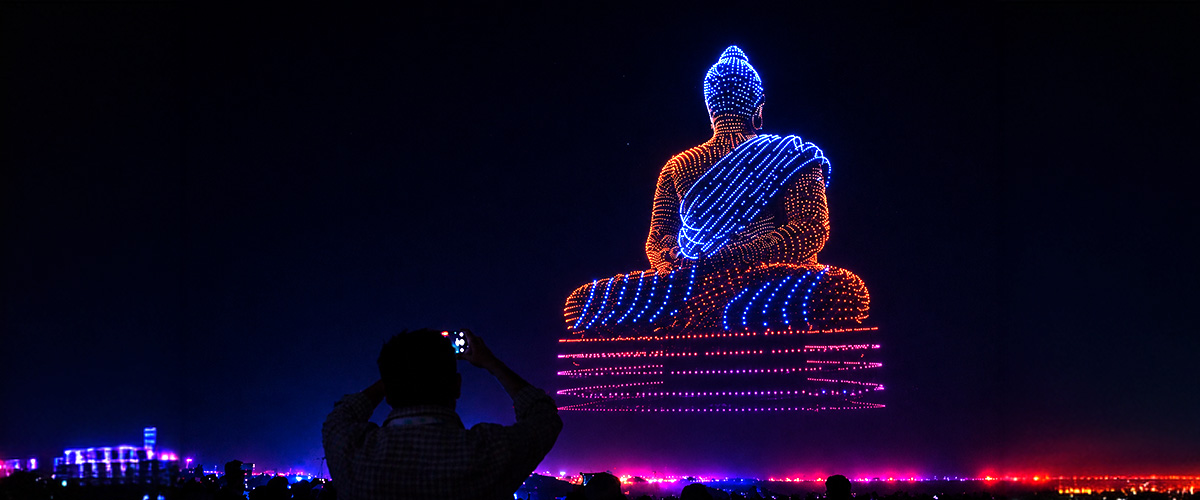
If you’re planning a drone show, here’s what actually matters: be clear on what kind of experience you want your audience to have. After that, work together with people who have experience with both design and technology.
Since an impressive drone show does not only depend on the performance itself, but also on the technology behind it.
Drone Programming vs Traditional Effects
Traditional effects like fireworks rely on timing and ignition. Drone shows rely on precision and control. Fireworks are linear; you launch and watch. Drone shows are dynamic; you design, test, and refine. That’s what makes them more complex, but also more powerful.
Final Thoughts
Drone formations may look effortless, but they are anything but. Behind every smooth transition and perfect visual is a system built on precision, planning, and programming. At BotLab Dynamics, this is where most of the work happens; long before the audience looks up.
Because in the end, a great drone show isn’t defined by how many drones you fly. It’s defined by how well you program them.