A drone light show is produced through weeks of rigorous engineering, extensive coding, and highly coordinated execution. The entire behind-the-scenes process of a drone light show display is an organized method of blending a creative concept with precise technical execution. Following through the storyboard and 3D pre-viz for the final flight, the workflow relies heavily on swarm programming, hardware calibrations, regulatory compliance, and real-time monitoring.
What Happens behind the Scene of a Drone Show
Behind-the-scenes processes for producing a drone light show follow a systematic pipeline of:
- Concept Development: Choosing an aerial narrative from a creative brief.
- 3D Animation & Programming: Programming the drone’s path of flight, group formations, and LED synchronization.
- Simulation Testing: Simulating the flight in a virtual environment before any drone leaves the ground.
- Hardware Preparation: Calibrate each drone in the fleet to avoid failures
- Regulatory Approval: Obtaining airspace permissions and legal documentation to operate drones in a particular region.
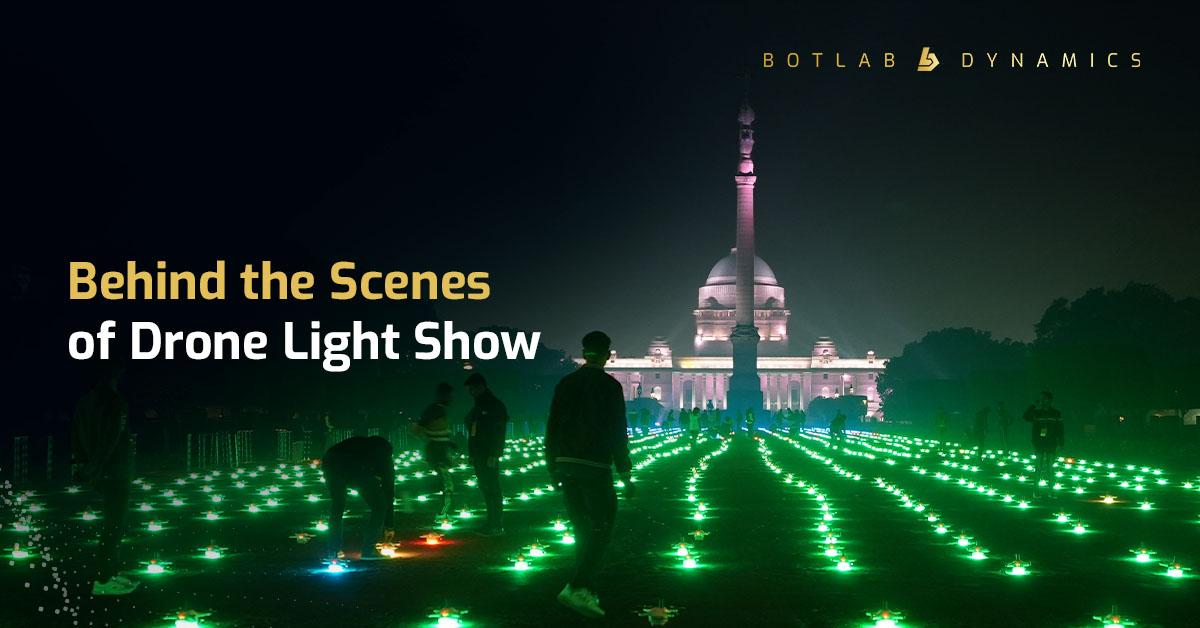
- Drone Show Prepping: Setting up ground control, launch pads, and communication systems.
- Aerial Show Execution: Controlling the drone performance in real-time from the ground while also monitoring the telemetry data.
- Post-Show Analysis: Reviewing the flight data to make adjustments for future performances.
Step 1: Concept Development & Storyboarding
Each show has a creative objective. What message should the show represent? What emotion should it invoke in the audience?

The production team conducts a venue recce prior to the show. This is done to analyze different variables of that venue including its size, sight lines, and ambient lighting. A compact venue may require 200 drones, while a large outdoor stadium show may need 500 or more drones.
The visibility planning of the audience will determine the formation altitudes, angular spreads and transition pacing. Written narratives and brand messages are then converted into geometric formations and motion sequences. Each scene is storyboarded to have a time-coded visual script.
Step 2: 3D Animation & Coding of the Drone Aerial Display
Once the Storyboard has been signed off, the Series of Engineers will perform the most technically challenging part of developing the Drone Show, the actual drone show programming
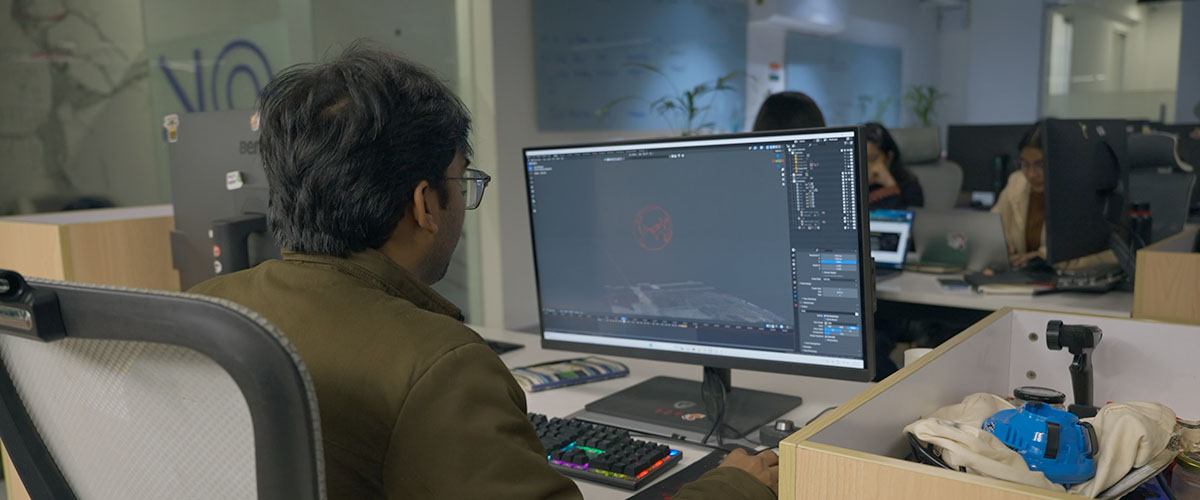
A Drone is assigned GPS coordinates to each individual moment of the entire show. Each L.E.D. Color value is programmed for each drone in each frame with respect to the total visual composition of the entire show. Swarm algorithms define how each drone unit communicates its position information and reacts to the actions of its neighbours.
Simulated and Virtual Testing- Prior to using hardware, engineers will run the entire show in a simulation environment. They will validate.
Collision Detection- Verify that no two drone flight paths will be in unsafe proximity to each other.
Wind Modelling- Understanding how wind speed relates to drone location accuracy.
Time Synchronisation Verification- Ensuring that all units respond to the command signals with acceptable latency.
Formation Accuracy- Ensure complicated patterns appear correct at the height at which the drones will be flying.
There will be multiple iterations of the simulated environmental performance until all of the performance metrics have been met.
Step 3: Prep the Hardware for Perfect Calibration
Attention now turns to getting a fleet of drones physically ready for flight after verifying the successful operation of the software. All flight operations for each drone will follow these four standard procedures:

Battery Management - Each battery will completely cycle through the charger to verify performance including full charge, capacity and discharge rates.
Firmware Update - This will ensure that every drone is operating with the same, tested software version.
GPS Calibration - Each drone should have a good satellite lock and be within specification under anticipated sky conditions before flying.
LED Inspection - Each drone will have its output color inspected for consistency with the other drones, as well as the levels of brightness.
Communications redundancies - All of the drones data links, such as radio, will be tested to verify they are operational as a backup communication system.
If one drone is not calibrated correctly, then the whole formation will fail. Therefore, this step should be performed methodically, rather than quickly.
Step 4: Regulatory Compliance issued by Civil Aviation Authorities
In India, commercial drone operations are regulated by DGCA (Directorate General of Civil Aviation), and prior to operating drones the operator must obtain permission via the Digital Sky Platform. The operator (that is, commercial pilot) must provide a detailed flight plan that includes the following information: altitude, coordinates, number and type of drones, anticipated Date, Time, and duration of use.

In addition to making the required regulatory filings, the overall compliance process must include the following:
Risk Mitigation Planning - Identify possible risks to the operation and develop response protocols.
Geofencing - Use Programmable Hard Boundaries in the Software of Each Drone That Will Prevent Infringement of the Airspace.
Emergency Landing Protocols - Assign Emergency Landing Locations for Any Drones That Need to Abort During the Event.
Establish Real- Time Telemetry Monitoring Procedures and Assign a Ground Crew to Monitor the Operation During the Event.
Compliance is not merely a formality, compliance is an engineering discipline used to protect people/companies flying drones; operators will suffer no injury, and the integrity of the airspace is protected.
Step 5: On-Site Prepping
On event day, the ground crews will carry out a specific deployment sequence of:
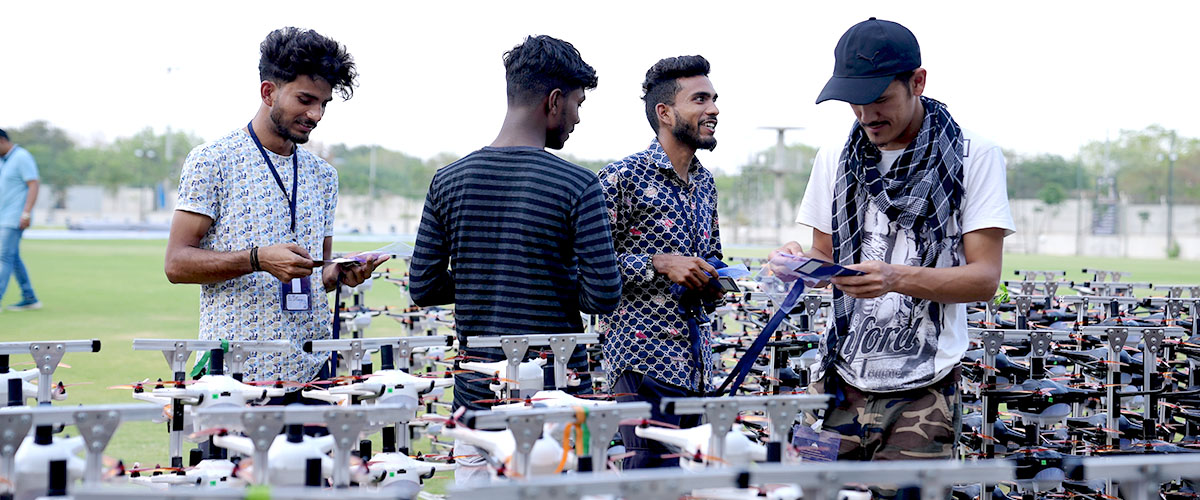
On event day, the ground crews will carry out a specific deployment sequence of:
Launch grid alignment - Drones will be positioned at pre-mapped GPS coordinates with centimetre-accuracy
Ground control station configuration - The software will be loaded, communications channels verified and failsafes will be armed
Weather checks - Wind speed, wind gusts, precipitation probability and visibility will be checked against operational limits prior to launch
Synchronisation validation - A final system-wide check will make sure all units are networked and time-synchronised
Redundant Network Tests - Back-up communication paths will be confirmed as active
Engineers and ground technicians will continue to work together during this phase.
The Technology behind Modern Drone Shows
Modern aerial display technology uses many different types of overlapping technologies.
Swarming Intelligence - A type of decentralized coordination that allows hundreds of drones to work together as one unit in an efficient and coherent manner.
RTK Precision GPS - This was created for precision at the centimeter level and allows for very tight formations of multiple drones to be flown.
Professional Flight Control Software - Very specific software to help convert animations into executable flight commands.
Redundant Communication Systems - Use of multi-channel data links between all areas of a system to maintain all command integrity under all radio frequency environments.
Programmable High-Brightness LED Array - Programmable, very high-brightness, LED-based lighting systems that can create thousands if not millions of colors.
Every one of these layers is built on the next one. If you take away any one of the layers you affect the performance of the entire system.
The BotLab Approach to Drone Light Show Excellence
A drone light show executed by BotLab Dynamics is more than just an aerial display of lights. It's the result of combining creativity with precision and safety to produce a one-of-a-kind spectacular display.
Each drone light show is produced after months of simulation testing to reduce potential risks. This is done by developing a robust risk mitigation plan. BotLab's integrated approach ensures that formation accuracy, operational safety and stunning visual displays are produced accurately each time the show is executed.